Buy dzug.eu ?
We are moving the project
dzug.eu .
Are you interested in purchasing the domain
dzug.eu ?
domain@kv-gmbh.de · 0541-91531010
Buy dzug.eu ?
What is the difference between strictly monotonic increasing and monotonic increasing?
Strictly monotonic increasing means that the function is always increasing and never stays the same, while monotonic increasing means that the function is always increasing or staying the same. In other words, a strictly monotonic increasing function will always have a positive slope, while a monotonic increasing function can have a zero slope at certain points. Therefore, strictly monotonic increasing functions are a subset of monotonic increasing functions. **
What is monotonic behavior?
Monotonic behavior refers to a consistent and unidirectional trend in a set of data or a mathematical function. In a monotonic increasing function, the values consistently increase as the input variable increases. Conversely, in a monotonic decreasing function, the values consistently decrease as the input variable increases. Monotonic behavior is important in various fields such as economics, engineering, and mathematics, as it helps in understanding and predicting the behavior of systems and processes. **
Similar search terms for Non-monotonic
Top-Angebote
Products related to Non-monotonic:
-
Arctic Hayes Infrared Digital Thermometer – Non-ContactArctic Hayes Infrared Digital Thermometer – Non-Contact (AH650) The Arctic Hayes Infrared Digital Thermometer is a fast, accurate and reliable tool for measuring temperatures of hard-to-reach surfaces without physical contact. A unique 12-point circular laser targeting system gives precise, clear readings every time. With a temperature range of -30°C to +380°C (-22°F to 716°F), this professional-grade thermometer suits HVAC engineers, plumbers, electricians and general trades. Its bright LCD display, built-in alarms and compact design make it a practical choice for quick diagnostics, safety, accuracy and ease of use. Key Features & Benefits Non-Contact Measurement: Measure temperatures of hard-to-reach surfaces without direct contact. 12-Point Circu43,50 £*Shipping: 5,00 £Secure redirect to the provider
-
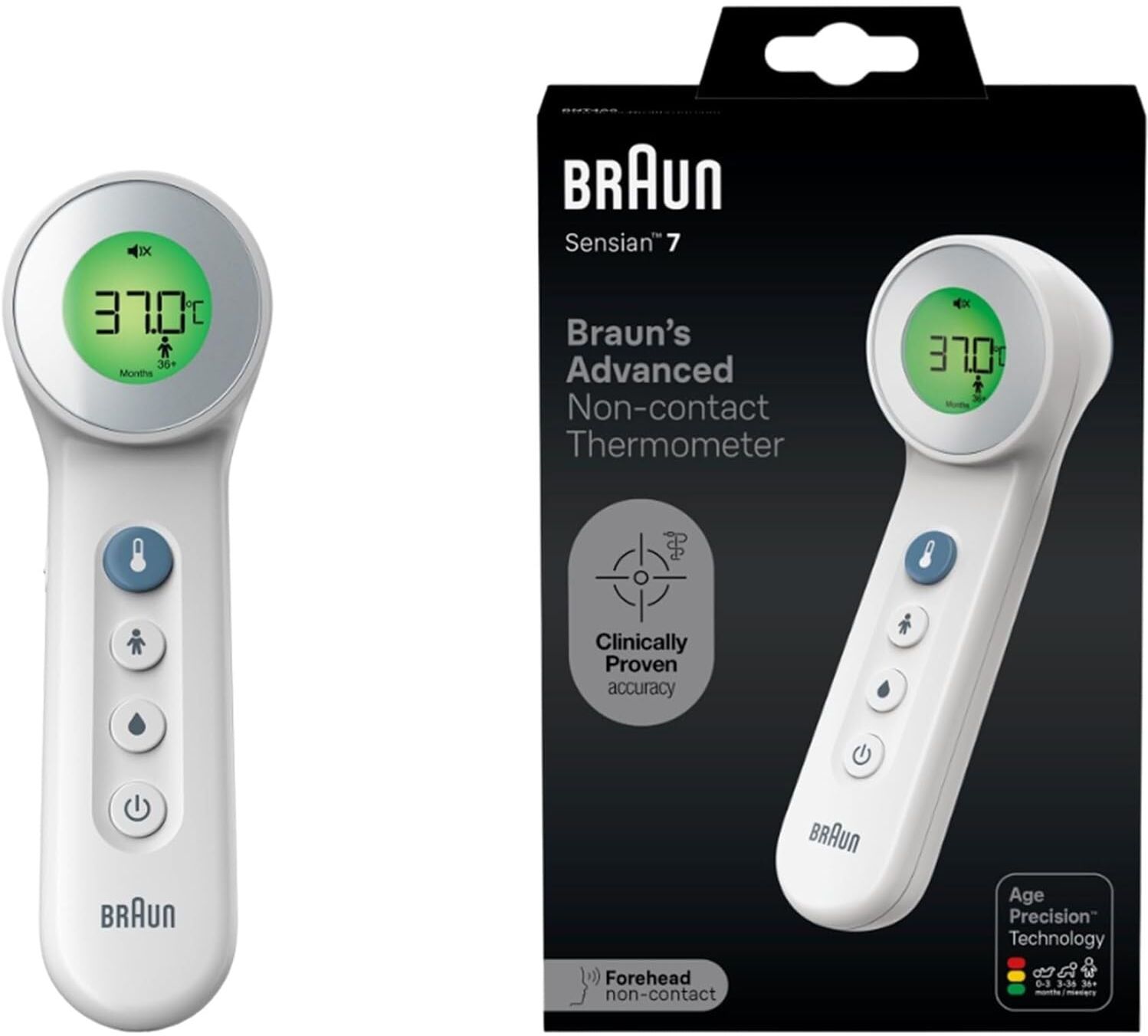
Braun Sensian 7 Forehead non-contact thermometer - Age Precision Technology - 3-in-1 Colour-Coded Digital Display - Baby and Child Friendly - BNT400B, New✅ Braun Sensian 7 Forehead Thermometer – BNT400B Model: BNT400B Type: Non-Contact Forehead Thermometer Technology: Age Precision™ Use: Baby, Child & Adult Take the stress out of temperature checks with the Braun Sensian 7 BNT400B Forehead Thermometer – the smart, gentle, and hygienic way to monitor your family’s health. ✅ No-Touch & Touch Mode Designed for maximum convenience, this thermometer offers dual measurement modes : No-touch mode : Read temperature without disturbing your child (ideal for sleeping babies). Touch mode : Simply place it gently on the forehead for a quick reading. ✅ Age Precision™ Technology Not all fevers are the same across age groups. With Braun’s unique Age Precision™ setting, you can select the age of the person (0-3 months, 3-36 months, or 36+ months), and the thermometer will interpret the reading accordingly to give a more accurate guidance. ✅ Colour-Coded Fever Guidance Quickly understand the result with a colour-coded digital display : ✅ Green – Normal temperature ⚠️ Yellow – Elevated temperature ❗ Red – High fever Perfect for giving you instant peace of mind when you need it most. ✅ 3-in-1 Functionality A truly versatile health device: Forehead temperature reading Object temperature – Check baby’s bottle, food, or bathwater Room temperature – Ensure the nursery is just right ✅ Silent Mode for Night-Time Checks Use the silent mode and backlit display to take readings in the dark without waking your child – ideal for late-night checks. ✅ Fast & Accurate Readings Delivers a precise result in just 2 seconds , powered by Braun’s trusted German-engineered sensor technology for clinical accuracy. ✅ Hygienic & Safe No probe covers needed Non-invasive and gentle – Ideal for babies and toddlers Easy to clean and use daily ✅ Ideal For: Parents with babies, toddlers, and young children Home use for all family members Safe, quick temperature checks without stress or discomfort Make health checks easier, faster, and more accurate with the Braun Sensian 7 BNT400B – your trusted partner in family wellness.37,49 £*Shipping: 0,00 £Secure redirect to the provider
-
Kingston Technology 240G DC2000B PCIe 4.0 M.2 2280 Enterprise SSD (Non-Heatsink)Enterprise class for server applicationsKingston’s DC2000B SSD is a high-performance boot drive designed for data centers using the latest Gen 4x4 PCIe interface with 3D TLC NAND. With low latency, IOPS consistency and hardware-based power loss protection, it ensures reliability and efficiency. Available in capacities of up to 960GB, it's ideal for enterprise server boot and caching applications. Kingston DC2000B is a high-performance PCIe 4.0 NVMe M.2 SSD using a Gen 4x4 PCIe controller and 3D TLC NAND. Ideally suited for use in high-volume rack-mount servers as an internal boot drive(s) to preserve valuable front-loading drive bays, as well as for use in purpose-built systems where a high-performance M.2 SSD is needed that includes hardware-based on-board power loss protection (PLP). New for DC2000B is an integrated aluminium heatsink that offers broader thermal compatibility for a wide range of systems. DC2000B delivers low latency and excellent IO consistency to handle various workloads from boot drive applications to high-speed application caching. DC2000B is rated at 0.4 DWPD write endurance and carries a 5-year warranty."PCIe 4.0 NVMe performanceUtilises PCIe Gen 4x4 lanes for high-performance speeds.On-board power loss protection (PLP)Reduce the possibility of data loss and/or corruption due to unexpected power-off.Low latency and IOPS consistencyFirmware optimised to deliver low latency and IO consistency for high duty cycle workloads.Designed for data center environmentsOptimised to meet the demands of server boot applications with low latency and IO consistency as the key design criteria.296,99 £*Shipping: 0,00 £Secure redirect to the provider



-
What is the difference between strictly monotonic decreasing/increasing and monotonic increasing/decreasing?
Strictly monotonic decreasing/increasing means that the function is either always decreasing or always increasing, without any flat regions or plateaus. Monotonic decreasing/increasing, on the other hand, allows for flat regions where the function remains constant. In other words, strictly monotonic functions do not have any horizontal sections, while monotonic functions may have horizontal sections. **
-
What is the difference between strictly monotonic increasing/decreasing and monotonic increasing/decreasing?
Strictly monotonic increasing/decreasing means that the function is either always increasing or always decreasing, without any flat regions or plateaus. Monotonic increasing/decreasing, on the other hand, allows for the possibility of flat regions or plateaus where the function remains constant. In other words, strictly monotonic functions do not have any horizontal sections, while monotonic functions may have some. **
-
What is strictly monotonic now?
A function is strictly monotonic if it is either strictly increasing or strictly decreasing. This means that for any two points in the function's domain, the function values at those points are either strictly increasing or strictly decreasing. In other words, the function does not have any plateaus or flat regions where the function values remain constant. **
-
Is every convergent sequence monotonic?
No, not every convergent sequence is monotonic. A convergent sequence is one that approaches a specific limit as the number of terms in the sequence increases. A monotonic sequence, on the other hand, is one that is either always increasing or always decreasing. While some convergent sequences may be monotonic, there are also convergent sequences that oscillate or have a mix of increasing and decreasing terms as they approach their limit. Therefore, not every convergent sequence is monotonic. **


How do you indicate that a function is strictly increasing or non-monotonic in an interval i?
To indicate that a function is strictly increasing in an interval i, you would show that for any two points a and b in the interval i, where a < b, the function value at a is less than the function value at b, i.e., f(a) < f(b). This would demonstrate that the function is strictly increasing in the interval i. To indicate that a function is non-monotonic in an interval i, you would need to show that there exist points a and b in the interval i, where a < b, such that the function value at a is less than the function value at b, and also points c and d in the interval i, where c < d, such that the function value at c is greater than the function value at d, i.e., f(a) < f(b) and f(c) > f(d). This would demonstrate that the function is non-monotonic in the interval i. **
How do you determine monotonic intervals?
To determine the monotonic intervals of a function, you need to analyze the sign of the derivative of the function. If the derivative is positive on an interval, then the function is increasing on that interval. If the derivative is negative on an interval, then the function is decreasing on that interval. By finding the intervals where the derivative is positive or negative, you can determine the monotonic intervals of the function. **
Top-Angebote
Products related to Non-monotonic:
-
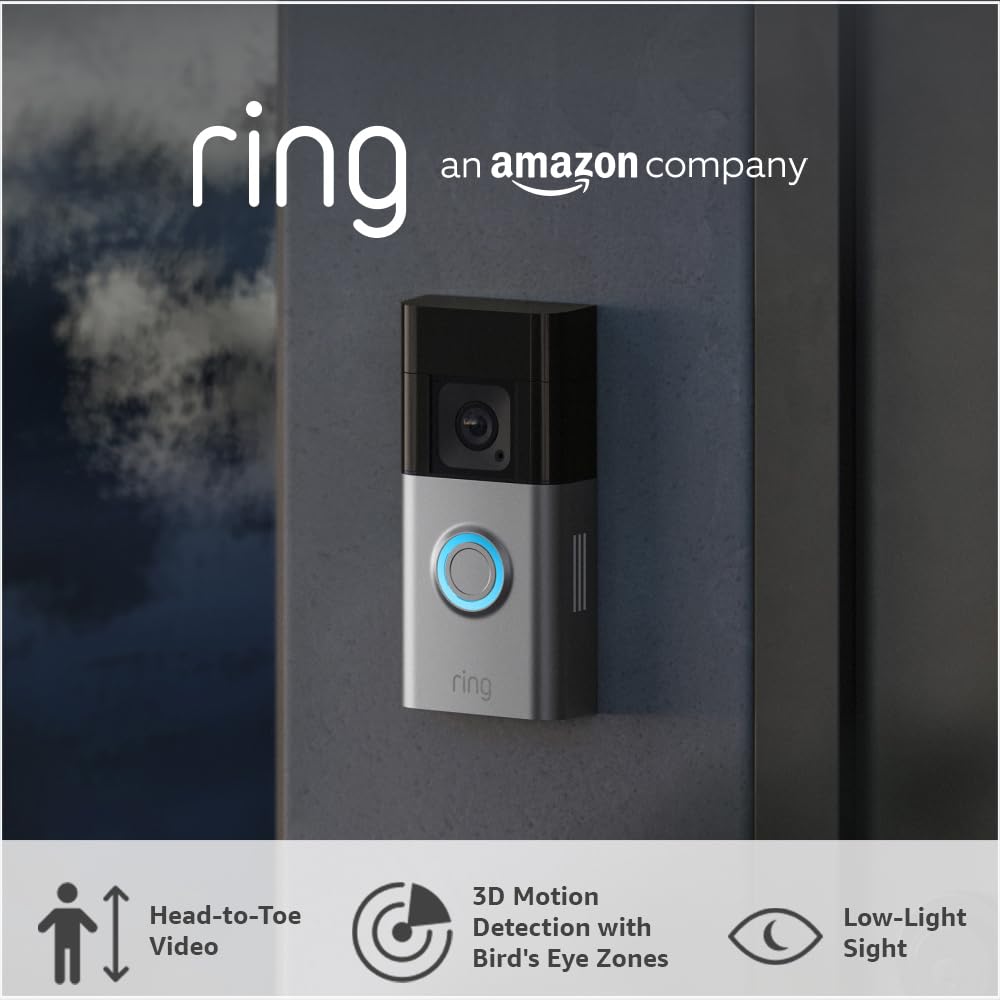
Ring Battery Video Doorbell Pro – Advanced Home Security & Connectivity, NewUpgrade your home security with the Ring Battery Video Doorbell Pro – Wireless Video Doorbell Security Camera . Designed to give you peace of mind, it delivers a head-to-toe 1536p HD view so you can see every detail clearly, from visitors to parcels at your doorstep. With advanced 3D Motion Detection and Bird’s Eye View , you’ll always know what’s happening around your home. The built-in colour night vision ensures crisp images even in the dark, while the wire-free battery design makes installation simple and flexible. Stay connected anywhere with instant notifications, two-way talk, and full integration with the Ring app, Alexa devices, and more. ✔️ Wireless video doorbell – Easy to install with a rechargeable battery, no wiring needed ✔️ 1536p HD head-to-toe view – See visitors and packages clearly in high definition ✔️ 3D Motion Detection & Bird’s Eye View – Advanced alerts and aerial perspective for extra security ✔️ Colour night vision – Crystal-clear video even in low light or darkness ✔️ Two-way talk with noise cancellation – Hear and speak to visitors in real time ✔️ Customisable motion zones – Focus on the areas that matter most ✔️ Smart alerts & notifications – Instant updates on your phone via the Ring app ✔️ Alexa compatible – Works seamlessly with Echo devices for hands-free monitoring ✔️ Quick-release battery pack – Easy to recharge and swap for uninterrupted security ✔️ Durable design – Built to withstand outdoor weather conditions The Ring Battery Video Doorbell Pro combines advanced motion detection, high-definition video, and smart home integration in one sleek device. Perfect for enhancing your home security, it ensures you never miss a visitor or delivery, day or night.174,49 £*Shipping: 0,00 £Secure redirect to the provider
-
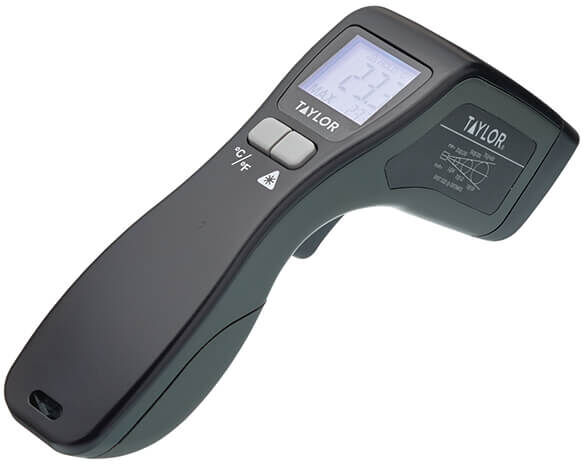
Taylor Pro Non-Contact Infrared Digital ThermometerThe Taylor Pro Digital Non-Contact Infrared Thermometer is a safe and hygienic way to take accurate temperature readings in an instant. Using infrared technology, this digital thermometer reduces the risk of cross food contamination as it doesn't have to come into contact with food. A quick squeeze of the trigger and this this thermometer will instantly provide a reading - from -45°C to 400°C (-49°F to 752°F). This infrared thermometer is particularly good for liquid recipes for which temperature is key, such as caramel, melted chocolate, sauces, syrups and soups. It can also be used to check if woks, pans and griddles are hot enough for frying, searing and sauteing, reducing the risk of scalds and burns. The Taylor Pro Digital Non-Contact Infrared Thermometer requires 2x AAA batteries (not supplied) and measures 10cm x 4cm x 15cm.39,99 £*Shipping: 3,50 £Secure redirect to the provider
-
Arctic Hayes Infrared Digital Thermometer – Non-ContactArctic Hayes Infrared Digital Thermometer – Non-Contact (AH650) The Arctic Hayes Infrared Digital Thermometer is a fast, accurate and reliable tool for measuring temperatures of hard-to-reach surfaces without physical contact. A unique 12-point circular laser targeting system gives precise, clear readings every time. With a temperature range of -30°C to +380°C (-22°F to 716°F), this professional-grade thermometer suits HVAC engineers, plumbers, electricians and general trades. Its bright LCD display, built-in alarms and compact design make it a practical choice for quick diagnostics, safety, accuracy and ease of use. Key Features & Benefits Non-Contact Measurement: Measure temperatures of hard-to-reach surfaces without direct contact. 12-Point Circu43,50 £*Shipping: 5,00 £Secure redirect to the provider
-
Braun Sensian 7 Forehead non-contact thermometer - Age Precision Technology - 3-in-1 Colour-Coded Digital Display - Baby and Child Friendly - BNT400B, New✅ Braun Sensian 7 Forehead Thermometer – BNT400B Model: BNT400B Type: Non-Contact Forehead Thermometer Technology: Age Precision™ Use: Baby, Child & Adult Take the stress out of temperature checks with the Braun Sensian 7 BNT400B Forehead Thermometer – the smart, gentle, and hygienic way to monitor your family’s health. ✅ No-Touch & Touch Mode Designed for maximum convenience, this thermometer offers dual measurement modes : No-touch mode : Read temperature without disturbing your child (ideal for sleeping babies). Touch mode : Simply place it gently on the forehead for a quick reading. ✅ Age Precision™ Technology Not all fevers are the same across age groups. With Braun’s unique Age Precision™ setting, you can select the age of the person (0-3 months, 3-36 months, or 36+ months), and the thermometer will interpret the reading accordingly to give a more accurate guidance. ✅ Colour-Coded Fever Guidance Quickly understand the result with a colour-coded digital display : ✅ Green – Normal temperature ⚠️ Yellow – Elevated temperature ❗ Red – High fever Perfect for giving you instant peace of mind when you need it most. ✅ 3-in-1 Functionality A truly versatile health device: Forehead temperature reading Object temperature – Check baby’s bottle, food, or bathwater Room temperature – Ensure the nursery is just right ✅ Silent Mode for Night-Time Checks Use the silent mode and backlit display to take readings in the dark without waking your child – ideal for late-night checks. ✅ Fast & Accurate Readings Delivers a precise result in just 2 seconds , powered by Braun’s trusted German-engineered sensor technology for clinical accuracy. ✅ Hygienic & Safe No probe covers needed Non-invasive and gentle – Ideal for babies and toddlers Easy to clean and use daily ✅ Ideal For: Parents with babies, toddlers, and young children Home use for all family members Safe, quick temperature checks without stress or discomfort Make health checks easier, faster, and more accurate with the Braun Sensian 7 BNT400B – your trusted partner in family wellness.37,49 £*Shipping: 0,00 £Secure redirect to the provider
-
What is the difference between strictly monotonic increasing and monotonic increasing?
Strictly monotonic increasing means that the function is always increasing and never stays the same, while monotonic increasing means that the function is always increasing or staying the same. In other words, a strictly monotonic increasing function will always have a positive slope, while a monotonic increasing function can have a zero slope at certain points. Therefore, strictly monotonic increasing functions are a subset of monotonic increasing functions. **
-
What is monotonic behavior?
Monotonic behavior refers to a consistent and unidirectional trend in a set of data or a mathematical function. In a monotonic increasing function, the values consistently increase as the input variable increases. Conversely, in a monotonic decreasing function, the values consistently decrease as the input variable increases. Monotonic behavior is important in various fields such as economics, engineering, and mathematics, as it helps in understanding and predicting the behavior of systems and processes. **
-
What is the difference between strictly monotonic decreasing/increasing and monotonic increasing/decreasing?
Strictly monotonic decreasing/increasing means that the function is either always decreasing or always increasing, without any flat regions or plateaus. Monotonic decreasing/increasing, on the other hand, allows for flat regions where the function remains constant. In other words, strictly monotonic functions do not have any horizontal sections, while monotonic functions may have horizontal sections. **
-
What is the difference between strictly monotonic increasing/decreasing and monotonic increasing/decreasing?
Strictly monotonic increasing/decreasing means that the function is either always increasing or always decreasing, without any flat regions or plateaus. Monotonic increasing/decreasing, on the other hand, allows for the possibility of flat regions or plateaus where the function remains constant. In other words, strictly monotonic functions do not have any horizontal sections, while monotonic functions may have some. **
Similar search terms for Non-monotonic
-
Kingston Technology 240G DC2000B PCIe 4.0 M.2 2280 Enterprise SSD (Non-Heatsink)Enterprise class for server applicationsKingston’s DC2000B SSD is a high-performance boot drive designed for data centers using the latest Gen 4x4 PCIe interface with 3D TLC NAND. With low latency, IOPS consistency and hardware-based power loss protection, it ensures reliability and efficiency. Available in capacities of up to 960GB, it's ideal for enterprise server boot and caching applications. Kingston DC2000B is a high-performance PCIe 4.0 NVMe M.2 SSD using a Gen 4x4 PCIe controller and 3D TLC NAND. Ideally suited for use in high-volume rack-mount servers as an internal boot drive(s) to preserve valuable front-loading drive bays, as well as for use in purpose-built systems where a high-performance M.2 SSD is needed that includes hardware-based on-board power loss protection (PLP). New for DC2000B is an integrated aluminium heatsink that offers broader thermal compatibility for a wide range of systems. DC2000B delivers low latency and excellent IO consistency to handle various workloads from boot drive applications to high-speed application caching. DC2000B is rated at 0.4 DWPD write endurance and carries a 5-year warranty."PCIe 4.0 NVMe performanceUtilises PCIe Gen 4x4 lanes for high-performance speeds.On-board power loss protection (PLP)Reduce the possibility of data loss and/or corruption due to unexpected power-off.Low latency and IOPS consistencyFirmware optimised to deliver low latency and IO consistency for high duty cycle workloads.Designed for data center environmentsOptimised to meet the demands of server boot applications with low latency and IO consistency as the key design criteria.296,99 £*Shipping: 0,00 £Secure redirect to the provider
-
Happy Pet Pantry Non Contact Pet Ear Thermometer For Dogs & Cats Digital Veterinary Fever Monitor Non Contact Pet Ear Thermometer For Dogs & Cats Digital Veterinary Fever MonitorWhen your pet feels unwell, every second of uncertainty feels overwhelmingquick, accurate temperature checks can bring peace of mind. This pet ear thermometer is designed to deliver fast and reliable readings for dogs, cats, and puppies without...34,97 $*Shipping: 0,00 $Secure redirect to the provider
-
TOWN & COUNTRY EVERYDAY Rein Abstract Cloud Everwash Washable Non-Slip Backing Area RugThe Rein Everwash Machine Washable Area Rug is a perfect addition to any home! This hardwearing rug is ideal for high-traffic areas - use as a kitchen rug, living room rug, dining room rug, or entryway rug.117,80 $*Shipping: 0,00 $Secure redirect to the provider
-
What is strictly monotonic now?
A function is strictly monotonic if it is either strictly increasing or strictly decreasing. This means that for any two points in the function's domain, the function values at those points are either strictly increasing or strictly decreasing. In other words, the function does not have any plateaus or flat regions where the function values remain constant. **
-
Is every convergent sequence monotonic?
No, not every convergent sequence is monotonic. A convergent sequence is one that approaches a specific limit as the number of terms in the sequence increases. A monotonic sequence, on the other hand, is one that is either always increasing or always decreasing. While some convergent sequences may be monotonic, there are also convergent sequences that oscillate or have a mix of increasing and decreasing terms as they approach their limit. Therefore, not every convergent sequence is monotonic. **
-
How do you indicate that a function is strictly increasing or non-monotonic in an interval i?
To indicate that a function is strictly increasing in an interval i, you would show that for any two points a and b in the interval i, where a < b, the function value at a is less than the function value at b, i.e., f(a) < f(b). This would demonstrate that the function is strictly increasing in the interval i. To indicate that a function is non-monotonic in an interval i, you would need to show that there exist points a and b in the interval i, where a < b, such that the function value at a is less than the function value at b, and also points c and d in the interval i, where c < d, such that the function value at c is greater than the function value at d, i.e., f(a) < f(b) and f(c) > f(d). This would demonstrate that the function is non-monotonic in the interval i. **
-
How do you determine monotonic intervals?
To determine the monotonic intervals of a function, you need to analyze the sign of the derivative of the function. If the derivative is positive on an interval, then the function is increasing on that interval. If the derivative is negative on an interval, then the function is decreasing on that interval. By finding the intervals where the derivative is positive or negative, you can determine the monotonic intervals of the function. **
* All prices are inclusive of VAT and, if applicable, plus shipping costs. The offer information is based on the details provided by the respective shop and is updated through automated processes. Real-time updates do not occur, so deviations can occur in individual cases. ** Note: Parts of this content were created by AI.